

The Best Bank in Cambodia: A 2026 Guide to Tech, POS, and the Reality of SME Loans
Over the past 15 years of working and doing business related to event and travel services including operating current SAM INSPIRE, a boutique event agency and destination management company based right here in Siem Reap, Angkor, Cambodia, I have had to navigate every financial hurdle imaginable. From paying local vendors and running staff payroll to receiving massive international corporate transfers for event management and travel package fees, I have seen it all.
I am constantly asked by expats, travelers, and foreign investors: “Sam, what is the actual best bank in Cambodia?”
This article about the best banks in Cambodia isn’t a copy-paste of a corporate brochure. It is a direct reflection of my personal, hands-on experience as a business owner in the Kingdom of Wonder. A lot has changed since my last update back in 2021. We have seen massive digital innovations, the expansion of cross-border payment systems, and some serious regulatory crackdowns.
Most importantly, I want to share the hard truth about securing business funding and managing hidden corporate fees in Cambodia today. Here is the unfiltered reality of banking in 2026.
The Regulatory Landscape: Commercial vs. Specialized Banks
The banking and financial institutions in Cambodia operate under the strict umbrella of the National Bank of Cambodia (NBC), in cooperation with the Ministry of Economy and Finance.
My good friend, Mr. Lanh LEAP, who has been a banking professional for many years, always summarizes the system perfectly for me. The NBC categorizes banks into two main tiers based on their capital and authorized scope of operations (Deposit, Settlement, and Loans):
- Commercial Banks: As of 2026, there are slightly over 50 commercial banks operating in Cambodia (the exact number fluctuates as the NBC actively consolidates the market and revokes licenses of non-compliant institutions). These are globalized institutions requiring a minimum capital of KHR 300 Billion (approximately $75 million USD). They have the authority to do it all such as take customer deposits, handle massive domestic and international settlements, and issue comprehensive business and personal loans.
- Specialized Banks: These require a much lower minimum capital of KHR 60 Billion (approximately $15 million USD) and are limited to operating in only one of the three primary banking scopes. For example, a specialized bank might only handle settlements (like early mobile payment operators) or only handle specific loan activities (like Microfinance institutions). You may check the activities of AEON Specialized Bank (Cambodia) Plc. which is the most active bank in Cambodia as a reference.
Currency and Banknotes of Cambodia in 2026
The Khmer Riel KHR (៛) is the proud national currency of Cambodia. There are no coins presently used in the country; everything is paper currency. The smallest denomination you will encounter is the 50-Riel note.
The physical currency landscape has evolved rapidly to promote the local Riel over the US Dollar. Here are the most critical updates for 2026:
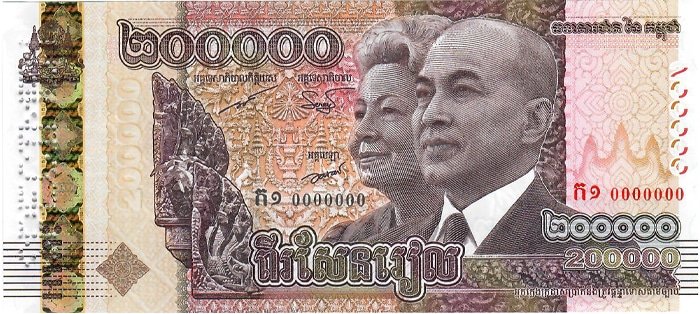
- The Highest Denomination: While the 100,000-Riel note was historically the largest, the NBC recently introduced a massive 200,000-Riel note (roughly equivalent to $50 USD) to commemorate the 20th anniversary of King Norodom Sihamoni’s coronation.
- Brand New Designs: Just recently, on September 25, 2026, the NBC officially launched newly redesigned 50,000-Riel and 100,000-Riel banknotes equipped with state-of-the-art anti-counterfeiting security threads. Both the old and new versions remain legal tender.
The Reality of the US Dollar: Even though the Riel is the national banknote, US Dollar currency is still widely used and transacted across the country. Generally, the exchange rate hovers around 4,000 KHR to $1 USD.
However, be highly warned: only perfect, crisp conditions of US Dollar notes are accepted! If your dollar bill has a slight tear, ink stain, or looks too worn out, it will be rejected everywhere. Moreover, as the NBC continues its de-dollarization push, small US bills under $10 ($1, $2, and $5 notes) are now heavily discouraged in daily commerce. Most businesses and ATMs will only dispense and accept Riel for small change.
The Dark Side: Why Bank Reputation Matters
When choosing a bank as a foreign investor or business owner, you cannot just look at app features; you must look at international trust. The NBC has become incredibly strict regarding compliance, operational stability, and cyber security to safeguard financial stability across the system.
The Cambodian banking sector is currently undergoing a massive, active clean-up phase. If you do not choose a reputable institution, you risk having your funds frozen during a regulatory liquidation. Here is the stark reality of what has happened in just the first half of 2026 alone:
- Prince Bank: Once heavily promoted, the NBC officially ordered Prince Bank into liquidation in January 2026 following massive international fraud investigations and sanctions.
- Panda Commercial Bank: On February 23, 2026, the NBC revoked its license after seven years of operation. The central bank cited continuous financial deterioration and a severe capital shortfall that made it impossible for the bank to continue offering services safely.
- CCU Commercial Bank Ltd, HH Bank (Cambodia) Plc, and Heng Feng (Cambodia) Bank Plc: In a sweeping regulatory move on August 3, 2026, the NBC officially revoked the banking licenses of all three of these commercial lenders simultaneously and ordered them into immediate liquidation.
When doing business globally, having your funds tied up in a liquidated or sanctioned institution is a nightmare. Always stick to the established, trusted giants.
Sam’s Pro Tip: Before opening a large corporate account, do not just rely on billboards. Always verify the bank’s active license status directly on the NBC’s official website under their “Supervision” directory. If they are missing from the current live PDF list, walk away.
The Digital Revolution: Bakong KHQR Goes Global
If you haven’t done business in Cambodia recently, the technology will blow your mind. The NBC’s Bakong (KHQR)system has completely unified the country. You no longer see five different QR codes sitting on a coffee shop counter. Today, one single KHQR code allows merchants to accept payments from virtually any mobile banking app in the nation.
This video highlighting one of the Cross-Border launching event between Cambodian and Vietnam, held in Sofitel Angkor Phokeethra Golf and Spa Resort in Siem Reap.
But the biggest leap in 2026 is that Bakong is now a cross-border powerhouse. Cambodia ranks second only to Thailand in cross-border payment integration within ASEAN. You don’t have to rely on expensive foreign exchange bureaus anymore. Using apps from major banks like ACLEDA or ABA, you can now scan and pay seamlessly in:
- Thailand (via PromptPay)
- Vietnam (via VietQR)
- Laos, Malaysia, and Singapore
- China (via Alipay) and South Korea
The money is deducted directly from your Khmer Riel account at highly competitive, real-time exchange rates. For a destination management company like SAM INSPIRE, this means our regional clients can pay us directly from their home country’s banking apps with zero friction.
Payment Gateways & The Elusive AMEX
For businesses processing online payments, White-Label Payment Gateways have become a critical asset. Top banks now provide secure payment gateways (like ABA’s PayWay) that integrate directly into business websites or create payment link for taking credit card payment online easily. Having this “white seal” of approval from a major bank provides a brand image of trust that gives international clients absolute confidence when booking large-scale events or tours online.
For physical point-of-sale (POS) machines, Visa, Mastercard, and UnionPay are accepted effortlessly by almost all commercial banks. However, American Express (AMEX) remains the elusive giant. When I pitch large US-based corporate groups for event services, having an AMEX payment solution is a massive competitive advantage. Currently, Maybank remains one of the very few banks in Cambodia whose credit card machines successfully process AMEX.
The Hard Truth About “Collateral-Free” SME Loans
Walk past any bank in Phnom Penh or Siem Reap today, and you will see massive billboards advertising “Collateral-Free” or “Unsecured” business loans. It sounds like a dream for a small business owner. But here is a personal reality check: SAM INSPIRE’s recent applications for unsecured business loans were rejected by both Wing Bank and Phillip Bank while these two banks advised their solutions grandly.
Why? It comes down to the Nature of the Business.
Banks in Cambodia have automated risk models that heavily favor businesses with tangible, physical products. If you apply for a collateral-free loan, the bank is looking for physical inventory that can act as a shadow guarantee, or extremely consistent daily retail cash flow.
The types of businesses that easily get approved for these “Unsecured” loans include:
- Retail & Wholesale Trading: Pharmacies, supermarkets, and electronics stores with physical inventory moving daily.
- Agriculture & Agribusiness: Farmers and agricultural suppliers (Wing Bank, for example, has specialized unsecured loan programs specifically for agribusinesses investing in climate-smart technology).
- Corporate Supply Chain Partners: Distributors of fast-moving consumer goods (FMCG).
- Manufacturing: Businesses with heavy equipment or raw materials on site.
Why Service-Based Businesses Get Rejected Boutique event agencies, destination management companies (like SAM INSPIRE), IT consultants, and marketing agencies are considered “Asset-Light.” We don’t have warehouses full of physical products.
Furthermore, service businesses in the tourism and events sector often operate on project-based, seasonal revenue rather than the steady daily cash flow of a retail shop. Because we sell expertise, experiences, and human capital rather than physical goods, banks view our industry as highly volatile and high-risk for unsecured lending.
The Workaround for Service Businesses: If you run an agency or service business without physical products, you have three real options for funding to try and dream:
- Secured Loans (Hard Title): Backing the loan with a traditional, fully registered L-Map (Hard Title). Most commercial banks strictly require this.
- Flexible Collateral (Soft Title): Finding a bank willing to underwrite based on a local commune-level “Soft Title.” Sathapana Bank is currently one of the absolute best options in the market for this, offering immense flexibility on a case-by-case basis.
- The CGCC: Exploring the Credit Guarantee Corporation of Cambodia (CGCC). This is a state-owned enterprise that provides credit guarantees for majority Cambodian-owned SMEs, acting as your collateral so you can unlock bank funding even if you are asset-light.
Sam’s Top Bank Picks for 2026
Every bank has its strengths, but these are the institutions that have actively powered my life and business.

1. ABA Bank (Advanced Bank of Asia) – The Tech Giant
I have voted ABA Bank as my top choice for years, and they still hold the crown for technological advancement. As a subsidiary of the National Bank of Canada, they are incredibly reliable.
- The Personal Perks: You can open an account with a $0 initial deposit. Their Cash-in and Check Deposit machines are everywhere especially in Siem Reap and Phnom Penh. My absolute favorite feature is their E-Cash (Cardless ATM withdrawal). For a minimal fee of just $0.10 per transaction, you can withdraw cash using only your phone.
- The Business Edge & Fees: One of the biggest advantages of ABA is that they do NOT charge any monthly maintenance fees for standard Business or NGO accounts. Keeping your corporate accounts active is completely free, making it incredibly cost-effective for daily operations and payroll.
- The Drawback (Loans): The major negative point about ABA Bank lies in their lending strictness. While their digital tech is unmatched, they are highly rigid with their collateral requirements. For substantial SME and corporate loans, ABA Bank strictly requires a Hard Title (L-Map) as collateral. If your property only holds a commune-level Soft Title, your business loan application will likely be rejected unless you go through the lengthy and expensive process of upgrading your land deed to a national level.
2. Sathapana Bank Plc. – The Flexible SME Partner
If you are an SME owner looking for capital and low overhead, Sathapana Bank needs to be on your radar.
- The Business Edge & Fees: Sathapana has two massive winning points for businesses. First, they offer zero monthly maintenance fees for corporate accounts, making them incredibly cost-effective to maintain. Second, their true standout feature is loan flexibility. While major banks will automatically reject your business loan if you do not have a hard land title, Sathapana actively accepts Soft Titles (Luy Path) for their SME, Overdraft, and Personal loans on a case-by-case basis. My successful loan application experience is credited to Mr. Sopheap Hoy, credit officer, who has been supportive, knowledgable and dynamic in the loan application preparing and processing.
3. Wing Bank (Cambodia) Plc. – The Digital Innovator
Wing, as part of the Royal Group, started as a specialized transfer service and has aggressively upgraded into a full-fledged Commercial Bank under the motto “Banking is now so easy.”
- The Ecosystem & Fees: Wing has a massive presence in the POS and merchant space. If you sell physical goods, their payroll solutions are incredibly streamlined, and their instant digital micro-loans are highly accessible. Moreover, similar to ABA, Wing Bank does not carry monthly maintenance fees for their corporate accounts, which means keeping the account open is entirely free.
4. Phillip Bank Plc. – The Traditional SME Lender
With Singaporean roots and over 70 branches nationwide, Phillip Bank is a strong contender for traditional businesses.
- The Ecosystem & Fees: They offer excellent international connectivity, including streamlined remittance services. While they rejected SAM INSPIRE’s asset-light loan application, they remain a fantastic choice for retail entrepreneurs. A massive winning point for Phillip Bank is that, like Sathapana, they offer zero maintenance fees for Business Accounts, making them a highly cost-effective alternative to the fee-heavy tech giants.
5. ACLEDA Bank Plc. – The Unmatched Local Giant
If we are talking true scale, ACLEDA is the undisputed heavyweight. They have the largest physical branch and ATM network across every single province in Cambodia. If your travels or CSR projects take you into rural areas, having an ACLEDA account is essentially mandatory. They are also heavily optimized for the NBC’s cross-border Bakong payments. Additionally, ACLEDA offers zero maintenance fees specifically for their KHR corporate accounts and charge some fees for other corporate account types.
Top 10 Active Banks in Cambodia (Alphabetical Order)
To give you a broader view, here is my curated list of the top reliable commercial banks actively operating in Cambodia in 2026.
- ABA Bank (Advanced Bank of Asia Limited)
- ACLEDA Bank Plc.
- Cambodian Public Bank Plc.
- Canadia Bank Plc.
- Foreign Trade Bank of Cambodia (FTB)
- J Trust Royal Bank Plc.
- Maybank (Cambodia) Plc.
- Phillip Bank Plc.
- Sathapana Bank Plc.
- Wing Bank (Cambodia) Plc.
(Note: To explore the complete regulatory list of all specialized banks and commercial banks, you can visit the National Bank of Cambodia (NBC) official website) here.
A Quick Note on Visas and Bank Accounts
Foreigners are highly welcomed to open bank accounts in Cambodia. You generally need a valid Passport, a Business Visa, and a Cambodian Employment Certificate (or Work Permit).
If you need consulting on Business Visas and Work Permits, I highly recommend contacting Ms. Savath THO (+855 12 703 928). She is a brilliant domestic travel agent with broad knowledge of visa applications and renewals. I use her services all the time and have never had an issue.
📝 Legal Disclaimer
The information provided in this article reflects the personal experiences, knowledge, and opinions of Sam and the SAM INSPIRE team. It is for general informational purposes only and should not be construed as official financial, legal, or professional business advice.
The banking sector and regulatory environment in Cambodia change rapidly. While we strive to provide accurate and up-to-date information, we make no representations or warranties regarding the completeness, accuracy, or current validity of the details mentioned. Any reliance you place on such information is strictly at your own risk. Readers are strongly encouraged to consult directly with the respective banks, legal professionals, or the National Bank of Cambodia (NBC) before making any financial decisions or loan applications.
SAM INSPIRE reserves the right to update, modify, or remove any content in this article at any time without prior notice as market conditions evolve.
SAM INSPIRE family hopes you find this deep dive useful for your research. If you need further support organizing an event, a corporate retreat, or just navigating business in Cambodia, feel free to contact us with the following contract details: